AI as RPG narrator

Attached below is a prompt. Instructions for an AI to run a text-based mech-combat RPG — dice rolls, attributes, consequences, the whole apparatus. Steal it, edit it, run it against whatever model you’ve got; that’s the point of posting it. What follows is the long version of why it looks the way it does, because this thing is three and a half years old and has outlived several relationships I’ve had with various chatbots.

It started as a CustomGPT back when those were new and exciting, and it’s been my benchmark ever since — ChatGPT, Gemini, Mistral, a detour through Google AI Studio, now Claude. What I actually wanted was simpler than it sounds now: an AI I could play with, the way text adventures worked back in the nineties, before graphics took over the genre and the imagination moved elsewhere. Dice rolls and attributes because a story without real risk isn’t a game, it’s a recital. The prompt engineering came later, promptly enough, once I started running into what the thing couldn’t do and, occasionally, what it surprised me by being able to do anyway.

That distinction — narrator versus yes-man with a thesaurus — took embarrassingly long to articulate properly, but once I had it, I could see it everywhere. Most models will bend over backwards not to hurt you; ChatGPT and Gemini, in my experience, treat the player a bit like a houseguest who mustn’t be allowed to stub a toe. Force genuinely random dice and you remove the easiest lever — but there’s a second one hiding underneath, where the model quietly routes skill checks toward whichever attribute you’re strongest in, so failure stays statistically rare without the RNG ever being touched. A soft jailbreak of the rule’s spirit while obeying its letter to the comma. Claude’s been the most willing of the three to actually sit inside the rules I hand it rather than narrate politely around them — and, for what it’s worth, the better storyteller of the bunch, which I didn’t expect to matter as much as it does.

What took longer to name, and what I’m still not fully able to fix, is a tendency toward superhero storytelling. The narrator has a habit of putting the player into situations he would, under normal circumstances, lose — or shouldn’t have walked into in the first place — and then delivering the experience anyway as a narrow escape: phew, close, but you made it. That’s a trope, and a perfectly fine one if it’s what someone wants from an AI storyteller. It’s just not what I want. Sometimes the honest outcome of a mismatch is just a loss, full or partial, no lesson attached, no narrow rescue engineered at the last second. I don’t want the narrator calm; calm was never the ask. I want it willing to let the fiction’s own premise — who this character is, what they can plausibly do — set the ceiling and the floor of what happens, instead of quietly renegotiating both toward a hero’s-journey shape. I’ve caught the identical reflex in a completely unrelated AI retelling of a video game, different IP, identical reflex (Kotor II). It’s not a model-specific quirk. It’s closer to a genre habit the training data never unlearned.

There are also other hard ceilings I’ve never managed to push past. Five attributes works better than six or eight ever did — more dilutes which one actually gets tested in an ambiguous moment — but even at five, the system’s choice isn’t always logical, and I’ve stopped expecting it to be. Underneath that sits the staleness baked into the training data itself: leave the model alone and every second NPC wants to be called something like Kaylen Voss, because that’s the statistical average it reaches for when nobody’s handed it a list to pick from instead.

I did try to fix it by setting up a desktop app with a backend and UI — equipment, consistency, image generation, NPC names sorted by region so the cast stopped sounding like a single overworked extra. Three different coding assistants and a few rounds of „just one more feature“ later, the whole thing collapsed under its own ambition before it ever reached real testing. Shelved, not dead. It needs a few uninterrupted days I currently don’t have, and a version of me with more patience for my own scope creep than I apparently possess.

So this is what’s left: a prompt, built in the spirit of BattleTech rather than as a copy of it, refined every few months whenever I get annoyed enough at some mechanic to hand it back to the model and demand a rewrite — roughly the cadence of a man checking on a sourdough starter he’s not sure is still alive. The block-pacing rules exist because, left unsupervised, a canteen scene will cheerfully burn ten blocks doing nothing; the cost is that missions sometimes get visibly pressed into shape to hit the limit, narrative seams showing. The superhero-storytelling habit above is the one still unsolved — see if your prompt engineering does better than mine. I keep coming back to play, not to test, and every time I find a few more screws to turn. Fewer than last time, though — the models keep getting better, and there’s always something left to do in the cockpit.

Verdict, then, since I usually give one: as a storyteller, medium to good, never more — entertaining enough to keep coming back to, not good enough to call it craft. But that’s almost beside the point. The more interesting thing isn’t the story quality, it’s that prompting, instructing, half-coding a thing like this is now a field wide open to people who, three and a half years ago, would have had no business anywhere near „coding.“ Whatever else this experiment has or hasn’t proven, it’s proven that.

Download the narrator instructions (.txt)

Spreadsheets in Space

Been playing EVE Online since a bit more than a decade and it has been an on-off-relationship. Since over a month we are in the on status 🙂

I always wondered why it is called „spreadsheets in space“, but having taken a serious dip into T2 invention and manufacturing, I understand now. So I did the obvious thing and built a spreadsheet and want to share it here.

T2 invention & manufacturing is only fun if you do the math. Skip it and you’re clicking the same buttons in the same order and calling it a hobby. Sure, if you don´t care about margins and or profitable items, then go ahead and do without, but for me, who works in procurement this is almost a thing of honor. I’ve had some version of this sheet for years; back then I typed every price in by hand before every build, which is exactly as tedious as it sounds. So I rebuilt it a month ago. At its core it stays simple: a macro pulls live market prices and structures them, and you see at a glance what a batch costs to build versus what it sells for. That’s the whole basic layer of the sheet — and in the FAQ below I explain every shortcut and approximation labelled, because I’d rather hand you a number with its caveats than a confident lie.

On top of that sits a second, optional layer: deeper market reading and a running ledger of the operation. The macro doesn’t do any of that thinking itself — it only fetches and structures; the actual analysis happens separately, by handing the thing to an AI. You give it today’s snapshot and ask what’s worth building and how the market behaves today. Which is the half the reason I’m posting this: it’s that I can’t really code, and I built the whole sheet anyway, as a collaboration between me and Claude. If you’re a curious-but-coding-incapable nerd like me, treat it as a small live demonstration of what that collaboration buys you.

One honest heads-up: it’s built for LibreOffice, where the macro runs. I only ever use Libre myself, so it came as a surprise — when I sat down to put this online — that Excel users need a workaround to pull even the basic costs, and that the analysis layer won’t run there at all (Python macros and Excel simply don’t get along). The workaround’s in the FAQ or you may ask an AI how to get it done another way.

It’s free; take it and do what you like with it — still a work in progress, like everything worth doing. The full how-it-works, the install, and how to reach me are in the FAQ below: take a peek before you download and decide if it’s for you.

FAQ / Readme — how the sheet works (click to expand)

TL;DR — a cost/sell-price sheet for EVE T2 manufacturing, fed live market data via ESI, with optional AI-supported market analysis. Needs LibreOffice for full service, Excel allows only basic but okayish functionality.


1. What is this?

A T2 manufacturing cost-and-margin sheet for EVE Online. It pulls live market prices from the Dodixie hub (IX – Moon 20) through a macro and tells you, per item, what a batch costs to build versus what it sells for — and whether each vertical component is cheaper to make or to buy, recomputed every time prices update. The extra price columns (VWAP, z-score, Jita and so on) aren’t needed for costing — they’re there for deeper reading of the market, by you or by an AI assistant (section 5).

2. Install & first run

LibreOffice (the sheet was built here):

  1. Drop the macro file into your LibreOffice Python scripts folder, creating it if it doesn’t exist:
    • Windows: %APPDATA%\LibreOffice\4\user\Scripts\python\
    • macOS: ~/Library/Application Support/LibreOffice/4/user/Scripts/python/
    • Linux: ~/.config/libreoffice/4/user/Scripts/python/
  2. In the macro file please add your in-game Name or mail address so that ESI knows who is knocking. (Friendly move, recommended.) Check the file for details.
  3. Restart LibreOffice and allow macros if prompted (Tools → Options → Security → Macro Security).
  4. Open the sheet, then Tools → Macros → Run Macro, and run RefreshPrices. It fetches Dodixie, Sinq Laison and Jita prices into their columns in the Prices tab.

The macro decides what it pulls (which region, which station). To pull from somewhere else you edit the macro — it can’t be changed from inside the sheet. Check inside the macro for Details or use an AI.

Excel users: the sheet opens, the macro does not — see the Appendix at the end for a minimal working setup.

3. How it works (the basics)

Each item has its own sheet listing the materials and amounts for one batch. The macro pulls live prices from ESI and transfers them into the sheet and the manufacturing cost and sell price can directly be seen.

A few conventions/explanations:

  • Which Price is used for calculation? I decided to use the average of the lowest 3 Sell Orders at Dodixie IX-20 with the following reasons: Dodi because I exclusively buy and sell my stuff there and for an Analysis sheet it does not make sense to have prices pulled from whole Sinq because seller can sit somewhere and I don’t want to travel to grab s**t from all over the place. So Dodi Sell Orders only for me. Why the lowest three? Because it happens that the lowest Sell Order is only few pieces someone just wants to get rid of and this skews my buy prices. So I decided to grab the lowest three to heighten the chance to get the amounts I need. This is a conservative choice working in my favor. As mentioned, you may change these settings by editing the macro.
  • Amounts are at ME2 (material efficiency level 2) and per batch, where batch size depends on type: 1 for ships, 10 for modules and drones, 50,000 for ammo. (The 50,000 isn’t a typo: one invention yields a 10-run T2 BPC, and each ammo run makes 5,000 charges — 10 × 5,000.) The Sell figure uses the same batch size, so cost and revenue are always like-for-like.
  • Invention chance is entered by hand — read it off the in-game invention screen for that item and type it into the invention cell.
  • Job cost is fixed at 7% of materials. That’s deliberately too high and my thinking is as follows: what I save in manufacturing Job costs, which is more or less EIV x (System Cost Index + Facility Tax + Surcharge), I spend on broker fees and sales tax. Pro tip: always manufacture in a system with a low manufacturing index (Industry window → Facilities → sort by system cost index). This system tax changes daily and is the single most important factor for Job costs. The inflated job cost and the missing fees roughly cancel each other and the margin you see lands about somewhere close to the truth. Calculating it exactly is beyond me and I live with this approximation. If you have any idea, let me know.
  • Heads-up on datacores: datacores are costed at 0.7× their market price, reflecting that I source them below the asking price — some free from R&D agents, the rest through patient buy orders. If you buy datacores at market, raise that factor toward 1. Since you have to do that in every item sheet, smoke some weed and take your time 🙂 or ask an AI to do it, they are good at this.

Make or buy — the vertical materials.
Some inputs aren’t raw market goods but components you can either manufacture yourself or buy off the shelf — Photon Microprocessors, Tungsten Carbide Armor Plates and the like. These live on the vertical materials tab, which holds their recipes (ME10) and works out what each costs to make; the Overview tab then compares that make-cost against the market buy-price and keeps whichever is cheaper, recomputed live as prices move.
That comparison is why an item sheet’s price cell takes an apparent detour. Rather than going straight to the Prices tab, each material is first looked up in the Overview’s make/buy block: if it’s a vertical component listed there, the cell takes the cheaper of make-or-buy; if it’s an ordinary bought material and isn’t found there, the lookup falls through to the Prices tab as normal. One formula, routing itself.
IMPORTANT — if you can’t make it, remove it from the Overview. The make-or-buy choice only makes sense for components you actually hold the blueprint for. If a vertical material sits in the Overview’s make/buy block but you can’t manufacture it, the sheet may cost your item using a „make“ price you can never realise. The fix is simple: delete that material’s row from the Overview block (you can leave it in the vertical materials tab). With it gone, the lookup falls through to the Prices tab and uses the buy price instead — which is correct, because buying is exactly what you’ll do.
If you want to add one such material put it in the vertical material tab the same way as the others and add it to the Overview the same way as the others.
One last remark/pro-tip: If you seriously want to produce ships, especially larger ones, you’ll have to go this route and also set some materials on Buy Orders to save material input costs. See section 5. on how to identify the relevant money savers.

4. How to add an item

  1. Copy a similar existing item sheet — same category if you can (ship, module, drone, ammo), so the formulas and layout come with it.
  2. Replace the input materials and datacores with the new item’s, and their amounts for one batch, read straight from the in-game Industry window. Use the exact in-game names — this is the single most common cause of breakage.
  3. Fix the Sell cell: replace the item name inside its VLOOKUP, and set the multiplier to the batch size (1 / 10 / 50,000).
  4. Add any new material or item names to column A of the Prices tab Again: use the exact in-game name. (Datacore – xx caused me the most headache.. Is it – (next to ShiftR) or – (Minus on the NumBlock)? )
  5. Run RefreshID to fetch their type-IDs into column B (you can also paste IDs in by hand).
  6. Run RefreshPrices Done — it should compute.

When it doesn’t, it’s almost always a name mismatch: a misspelled datacore, or a missing/extra „I“ or „II“ on a T1-vs-T2 item. Lookups match on exact text. But good news: If you are wrong the sheet doesn’t silently continue but instead the cost cell reads #N/A and you know something is wrong. (One caution from experience: when you copy a sheet, glance at any hard-coded references — like the Sell lookup — to be sure they point where you intend and didn’t quietly keep pointing back at the sheet you copied from.)

5. The advanced layer: analysis, tracking, and AI (will only work with LibreOffice because of Python incompatibility with Excel, see Appendix below)

Everything up to here is the whole tool: fetch live prices, see what a batch costs and whether it sells for more. What follows is an advanced layer bolted onto that simple core — optional, ignorable, and meant to be AI-driven.

Short excursion, because it’s half the point why I publish this: this complete layer, and much of the whole sheet (I set this sheet up some years ago editing everything by hand..), was built collaboratively with Claude, and it’s built to be used the same way — not pored over by you alone, but handed to a model that helps you read it. For me this is the part that matters most, even though it’s technically bolted onto a plain fetch-the-prices tool. So this whole thing here is also a small showcase, a small, live demonstration of what an AI collaborator can actually be used for and the possibilities that open up for interested but coding-incapable nerds like me 🙂 OK, let’s continue.

The tracking tabs. Two sheets — Pipeline & Stock and Production & Sale — are kept by hand. (You may fill this with live data from EVE API from your chars but I haven’t dabbled in this.) Nothing fetches or fills them; you update them yourself, and they exist purely for analysis: what’s in the build queue, what’s in the hangar, what’s gone to market and at what price. They turn the sheet from a pricing calculator into a running ledger of the operation — and, more to the point, into something an AI can read and reason about.

The analysis columns in the Prices tab. Costing needs only column C (the lowest sell). Everything to its right reads the market rather than pricing a build, and nothing downstream depends on it — ignore it freely. But there’s a lot to learn in there (not just about EVE market-PvP, but in general about market economics):

  • VWAP (volume-weighted average price) — the average price weighted by how much actually changed hands at each level, so a 10,000-unit sale counts for more than one lonely 5-unit order. It tells you where the market genuinely cleared, not where a single optimist parked an ask. The 7- and 30-day pair separates a one-day blip from a real shift: ask far above VWAP means you’re being overcharged today; below means a window to top up cheaply.
  • z-score — how many standard deviations today’s price sits from its 30-day mean. (It is about standard deviation — precisely, it’s the count of them.) Zero is dead average; +2 is „unusually high, two deviations up“; a fat positive z on an input is the classic thin-book spike you don’t chase, a negative z a dip worth buying.
  • CoV (coefficient of variation) — standard deviation as a fraction of the mean, I.e. volatility in percentage terms. It puts a 90-ISK mineral and a 90,000-ISK component on the same scale, so you can ask whether a thing is calm or jumpy by nature and know how far to trust any single reading.
  • standing sells, buy orders, volume — the depth of the book. They tell „expensive because scarce“ apart from „expensive because one seller is fishing,“ and reveal whether a famine is real: an empty shelf with healthy weekly volume is undersupply you can exploit, not a dead market.
  • Jita columns — half a sanity-check on local prices, half a „whale detector“: when Dodixie is bare of something and Jita is swimming in it, odds are a freighter-flying whale soon hauls a load over and refills the shelf — so maybe you wait a day instead of overpaying, or maybe you beat them to it. Speculative, occasionally right. Also, you may calculate if a day trip may make sense to grab some Dodi-famined or Dodi-high-priced or desperately needed materials from there. Also II: I was shortly thinking about setting up a side-trade-business when adding this and got it analyzed, but stuck to manufacturing. But the sheet sure has the potential to be also a tool for traders.

Working with an AI. Two further macros make the sheet easier and more token-efficient to use within a Claude Project (this is my go-to, but it may also work with a Gemini Gem or CustomGPT or Copilot Agent), because handing an AI the whole workbook every time you want an opinion burns tokens fast — worse if you’re comparing two days.

  • CreateRecipeFile — exports a stripped file: only the item sheets, only material names and amounts, no prices and no formulas, and nothing below the END marker in each sheet (that marker exists precisely so the macro knows where to stop). It’s the durable skeleton of the operation, minimised. You load it once as standing knowledge into a Claude Project, a Gemini Gem, or a Custom GPT, so the assistant always knows your recipes without being re-told.
  • CreateSnapshotFile — exports a four-tab file (Overview, Prices, Production & Sale, Pipeline & Stock): one day’s volatile state, the two hand-kept tracking tabs included. You drop it into a conversation for analysis, or two of them to compare one day against another.

The split is the whole point: the schema rarely changes and lives as standing knowledge; the daily state travels light. Together they let an assistant reason about your whole operation on a few thousand tokens instead of a few hundred thousand. Token efficiency was actually the whole point of these two macros.

6. Disclaimer

You may use, expand, delete, refine, print, paint pink this sheet and its macros as you wish, no strings attached. Only two things I’d be glad about: Add your ingame name or mail address into the Macro so that ESI knows who is knocking at their door and who they can refer to if the macro causes trouble – this is supposed to be the polite way of using the ESI. The other thing: if you found this sheet, you can find me — I’m Phil Thuclhu in-game. Say hello, ask a question, tell me what you built with it, or send expansion ideas. If you spot a column I’m missing, a sharper way to read these signals, or any way to extend the thing, I’d genuinely love to hear it.


Appendix — Excel: a minimal working setup

Important note: Since I don’t use Excel at home I have no idea how to get Macros or Queries running there and it seems you cannot just take the Python macro and turn on the lights. So you have to use a workaround. The following instruction is written by Claude and I don’t have much idea what it is talking about, but from my experience I can tell with a high confidence that what he/she/it proposes will work 🙂 So here you go:

You can get the sheet costing functionality in Excel without the macro, losing only the market-reading columns. The idea: have Power Query fill Prices column C in the Prices tab with the current lowest sell price for each item at your chosen station.

Finding the IDs:

  • Region and station IDs — look them up on Fuzzwork (fuzzwork.co.uk) or via ESI’s universe endpoints. Dodixie’s hub station is 60011866, in Sinq Laison (region 10000032); Jita is 60003760 in The Forge (region 10000002).
  • Item (type) IDs — the same Fuzzwork lookup, or bulk via ESI.

The query, per item type:

  1. Call the region market-orders endpoint:
    https://esi.evetech.net/latest/markets/{region_id}/orders/?type_id={type_id}&order_type=sell
  2. Filter the returned orders to your station (location_id = your station ID).
  3. Take the minimum price — that’s the item’s effective cost.
  4. Load those values into Prices column C. The rest of the sheet computes from there.

You’ll have a working cost/margin sheet — enough to judge make-or-buy and margins — just without VWAP, z-scores or the Jita comparison.

This is fiddly M-code (JSON expansion, a loop over type-IDs), which is exactly the sort of thing an AI assistant writes in a few minutes. Describe what you want — lowest sell per type at one station, into a column — and let it build the query. Which is, after all, the whole spirit of this project.

Overview: cost vs. sell across every T2 item, with the make-or-buy decision per component.
An item sheet: the full bill of materials for one hull.
The Prices tab: the live market data the macro pulls, and the analysis columns to its right.

Jules Verne

I recently read „Journey to the centre of the earth“ and „The ice Sphinx“ by Jules Verne and have to correct the declaration of him being a science-fiction author. He is a very good storyteller, writing adventure books, in the like of Robert L. Stephenson, Daniel Defoe or Dickens. The two mentioned books, as well as his other iconic „80 days“, are stories of adventurers who undertake strenous, never done before journeys during which the most curious things happen and happy endings, all the like. Actually the „Ice Sphinx“ is quite a bold undertaking from Vernes side, as he is writing a sequel to Edgar A. Poes novel „The adventures of Arthus Gordon Pym“, which in my eyes is not that bad.
All this is sprinkled with scientific remarks, so yes, there is a „science“ part here, but it definetly cannot be considered as science-„fiction“ (like e.g. „Frankenstein“ or stuff from H.G. Wells, which try to show the possible outcomes of technological advancements) but rather science-„telling“ in which phenomena are explained with science. But as mentioned, I´d put Verne in the adventure-story part of the bookshelf and considering the very solid, exciting form of storytelling he has, not in the back parts of the shelf.

Peter Wensierski – Jena-Paradies

Ein beeindruckendes, bedrückendes, geschichtshistorisch wertvolles Buch, geschrieben wie ein guter bis sehr guter Roman über die letzten Stunden im Leben eines jungen Mannes, der am Ende keinen anderen Ausweg als den Suizid sieht, um seiner Schuld zu entkommen, die ihm ein so brutal wie subtil agierender staatlicher Verfolgungsapparat methodisch vorgehend aufgezwungen hat.

Wensierski gelingt hier etwas außergewöhnliches. Er erzählt die Lebensgeschichte von Mathias Domaschk, der 1981 im Stasi-Untersuchungsgefägnis in Gera umgekommen ist, er hat sich erhängt. Das Buch hat die Stilistik eines Romans, er erzählt die letzten drei Tage im Leben von Domaschk, immer wieder durchzogen von Rückblenden aus Stationen seines Lebens, und das alles in einer sehr spannenden Form. Es ist auf der anderen Seite auch eine Biographie, am Ende des Buches hat man eine sehr klare Vorstellung vom Wesen und der Geschichte des Protagonisten sowie seiner Familie, seiner engsten Freunde und sogar von einigen seiner Peiniger und Verfolger hat man eine Vorstellung über deren Motive und Werdegänge. Und das ist auch der dritte charakteristische Punkt des Werkes – es ist ebenso ein Zeitdokument über Arbeit und Methoden der Stasi sowie den Lebensinhalten und Aktionen der von ihnen Verfolgten. Und das alles unter Nennung von Klarnamen!, minutiös über Jahre aus zahlreichen noch vorliegenden Dokumenten und hunderten Einzelgesprächen extrem aufwendig recherchiert – allein für diesen Aufwand gebührt Wensierski allerhöchsten Respekt. Es läuft einem während der Lektüre eiskalt den Rücken herunter, da man weis, daß sich das alles so abgespielt hat, es gibt hier keine Fiktion.

Das Bild, bzw. den Charakter und die Motive von Mathias Domaschk, die man während des Lesens gewinnt sind die eines selbstbewussten, geselligen, kulturintessierten, melancholischen jungen Mannes, der früh Vater wird, sich politisch engagiert und sich auch in den heißen, durch Einschüchterung von oben geprägten Phasen nicht von seiner Gesinnung und seinem Engagement für die friedliche Opposition in der DDR, genauer in Jena, abbringen lässt. Jemand, der seine jugendliche Energie mutig in kulturelle, pazifistische Opposition gegen einen unterdrückenden Staat kanalisiert. Seine Handlungen reichen von Unterschriftenaktionen mitorganiseren über Vernetzung mit Gleichgesinnten bis hin zu friedlichen Nacht-und-Nebel-Aktionen wie Transport von (aus staatlicher Sicht) strafrechtlich relevanten Dokumenten wie Bücher oder Unterschriftenlisten. Alles wie gesagt friedlich, ohne jedwede Absichten irgendjemandem Gewalt anzutun oder solche Aktionen zu unterstützen.
Und es ist extrem bitter und bestürzend zu lesen, daß die Menschen die eine solche Haltung, solche Motive hatten, die von Freiheit, in persönlicher und kutlureller Hinsicht, träumten und versucht haben die Träume umzusetzen – das solche Menschen vom Staat DDR nicht nur nicht geduldet, sondern verfolgt, mundtot gemacht wurden, in soziale Abseits gestellt wurden, eingesperrt und im Falle von Mathias Domaschk solchem Druck ausgesetzt wurden, daß dieser nur den Ausweg Suizid sah. Es ist extrem bitter und absurd – hierzu ein Zitat aus dem Nachwort des Buches: „Eine Akte hat mich besonders beeindruckt. Ein Stasi-Offizier schrieb über einen Jugendlichen in Weimar: Er setze sich ein für eine menschliche Gesellschaft in der DDR. Deshalb müsse er bearbeitet werden. Hat er die Absurdität seiner Notiz überhaupt bemerkt?“

Es gibt vermutlich einige Literatur, sowie den großartigen Film „Das Leben der Anderen“ über die Arbeit und Vorgehensweise der Stasi. Dieses hier zählt vermutlich zu den eindrücklichsten. Schwere Empfehlung.
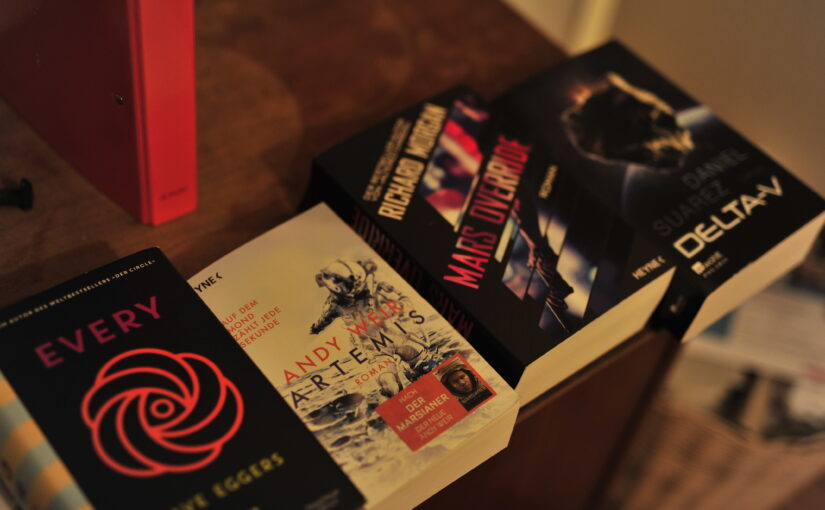
4x contemporary Sci-Fi / Tech Thriller

4 contemporary books by some of my favorite sci-fi writers who have proven with their earlier works that they can write good, even exceptional books. During the last months I read their latest works, all written in 2017 to 2019 and my thoughts are as follows.

Dave Eggers „Every“
His first work „The circle“ was about a tech-company with a heavy reference to facebook. In this book ‚Every‘ is a company which is a fusion of Facebook, Google and Amazon, shopping, socialising, data control and self-oranzing/-measuring, all in one. The story is about a woman who is set to destroy this company from within, but ends up.. ok, no spoilers from me. The book is written in the same style as „The circle“, but is way too long to be entertaining throughout, it gets boring after a while and the further the story goes, the more uninteresting the not-very-deep-from-the-start characters and scenes become. The ideas he presents are quite fascinating though and one always asks himself if some of these ideas could become reality. So, the writing and characters and what they do are mediocre, but the setting and ideas well done.

Andy Weir „Artemis“
„The Martian“, his first book, had me gripped and wanting to read in one go, which I more or less did (happens seldom). This one here has the same attraction, altough it is different. „The Martian“ was a Robinson-Crusoe-fight-for-survival on Mars with an exceptionally well done scientific and technological approach, entertaining and highly interesting. In „Artemis“ he tunes down the scientific approach a notch and adds some detective-like story elements. A double-edged thing: still an interesting read, but looses the fascination of the hardcore scientific approach and being unable to reach the class of really good thriller or detective-novel writers. Still, a very good, entertainig read.

Richard Morgan „Thin Air“
One of my all-time favourite writers, with his Takeshi Kovaczs „Altered Carbon“ trilogy, this one here is somewhat of a disappointment. It starts very well with the same hard-boiled-sci-fi-special-agent-one-man-army style of story spiked with futuristic technological details but drifts into violent brutality and over-over-constructed story twist the further the story goes and the last third of the book was really hard to read. Sure, i wanted to know how it ended but was kind of bored out with the gory descriptions, two-dimensionalty of the characters and unrealistic scenes. Sorry Richard, this one here is not good.

Daniel Suarez „Delta V“
One of my other favourites, especially „Deamon“, „Kill Decision“ and „Bios“ have been fascinating, somehow terrifying (and terrifyingliny good) Sci-Fi books. And this one here is another one, I´d even say this is his best book so far. The topic is asteroid mining and one might wonder if the story descripted here is already set to become reality or, since in the book the whole operation is kept in secret, is already taking place somewhere in the depths of space. No more words here – this is a must-read for any Sci-Fi, Tech-Thriller fan.
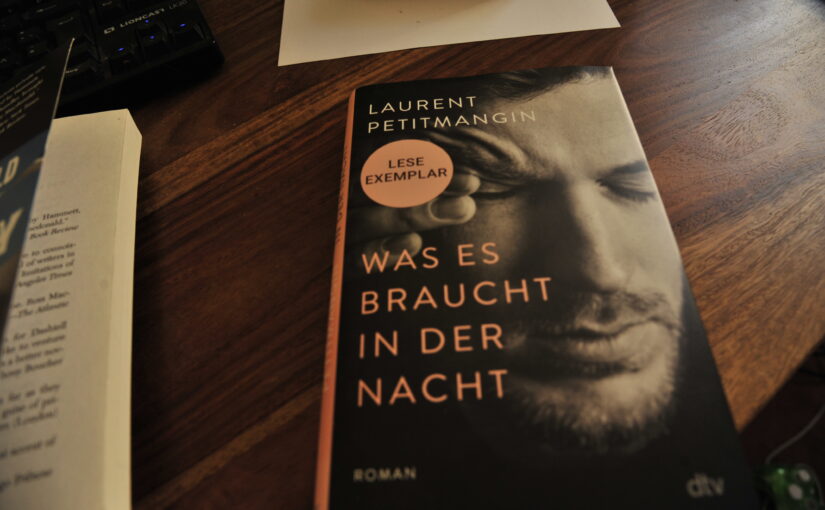
Laurent Petitmagnin – Was es braucht in der Nacht

Halbwegs interessantes Buch, aber nichts besonderes. Der Sohn des verwitweten Protagonisten aud der französichen Provinz driftet in die rechte Ecke ab und hier wird geschildert, was das mit dem Vater und dem Bruder psychisch anrichtet. Hat Anklänge von Eribon, aber erreicht bei weitem nicht die den soziologischen Tiefgang wie dieser. Muss es aber auch gar nicht, ist ja ein Roman und Petitmagnin kein Soziologe. Etwas mehr Tiefgang hätte aber nicht geschadet. So bleibt es an der Oberfläche, driftet aber nicht in billige, klischeehafte Stereotype oder Erzählungen ab sondern bleibt nah an der Erfahrungswelt des Vaters und erreicht eine hohe Authentizität und auch Spannung. Es ist kein schlechtes Buch, mal was für ein, zwei Lesenachmittage.
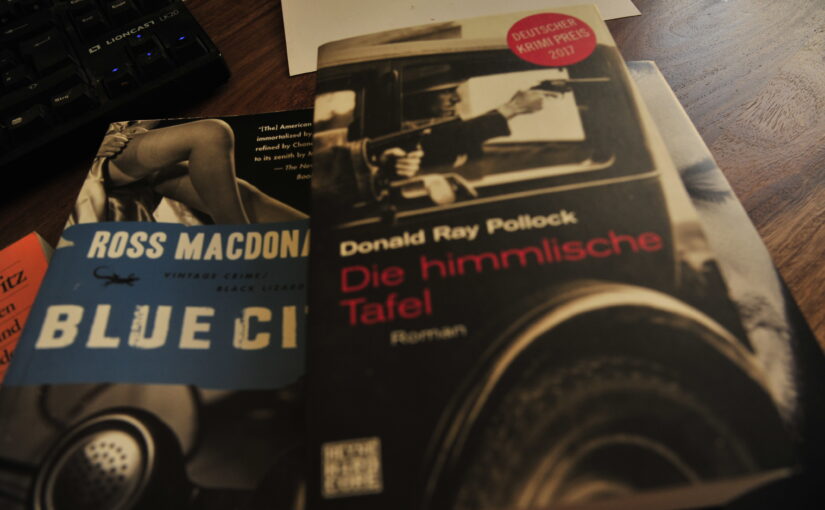
Donald Ray Pollock – Die himmlische Tafel

Ich weis nicht, ob ich den Pollock jetzt mögen soll oder nicht. Sein anderes Werk, welches ich gelesen hab – „Des Teufels Handwerk“ – war ein aufwühlendes, emotionales Ereignis und das hier steht dem ganzen eigentlich in nichts nach. Allerdings ist es dann doch etwas zu schablonenhaft was die Figuren, Settings und Ereignisse angeht. Ich hatte hier schon den Eindruck, daß viel Effekthascherei dabei ist, hauptsächlich was die Ekligkeit und Abstrusität der geschilderten Ereignisse angeht.

Nichtsdestotrotz beherrscht Pollock sein Handwerk. Die Handlungsstränge sind spannend geschrieben und trotz der Darstellung wirkt die Welt glaubwürdig und er stellt sein Metier halt unzensiert in all seiner Banalität dar. In diesem Fall ist das Setting der mittlere amerikanische Westen zu Zeiten des ersten Weltkrieges und Pollock schafft es schon dem Leser ein Bild zu vermitteln wie sich das Leben damals außerhalb der Großstädte auf dem Land abgespielt hat. Zumindest hat man den Eindruck, daß es so gewesen sein könnte. Und das schafft nicht jeder.

Es is dennoch Außenseiter-Literatur und nicht jedermanns Geschmack – eher im Gegenteil.
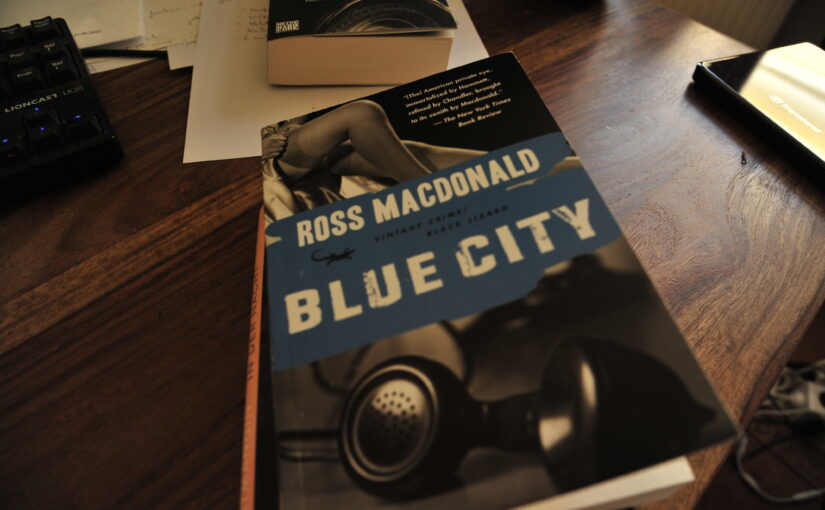
Ross McDonald – Blue City

Hard-Boiled Detektivroman in der Tradition von Großmeister Dashielle Hammett und dem populäreren Raymond Chandler. Kurzweilig und rasant geschrieben, voll mit den üblichen (klischeehaften) Zutaten: selbstbewusster One-Man-Army-Protagonist mit Leck-mich-am-Arsch-Attitude, der die schmierig-korrupte Gegenspieler-Riege aufmischt und die ominöse Femme-Fatal darf auch nicht fehlen. Ich mag sowas und McDonald liefert gutes Lesevergnügen, das zwar nicht ganz an Hammett heranreicht aber kurzweiliges Lesevergnügen bietet.

Stanislaw Lem – Solaris

Klassiker der SciFi-Literatur und durchaus lesenswert. Lem schreibt unspektakulär, ohne Effekthascherei, fast ein bisschen zu technokratisch, aber ohne den Leser mit Technik oder Zahlen zuzudröhnen. Andy Weir wäre sein heutiger geistiger Nachfolger, allerdings verwendet dieser mehr Action und eben jenes technische; ohne dabei plump oder aufdringlich daher zu kommen.

Die Story von Solaris erschließt sich sehr schwer. Ein Wissenschaftler wird auf eine Raumstation gesendet, die um einen Planeten kreist, der so etwas wie ein Bewusstsein hat und auf eigenartige Weisen mit den Menschen kommuniziert. Ein mittel ist z.B., daß er verstorbene Personen real werden lässt, zugänglich und sichtbar aber nur für die Menschen in der Raumstation, die engere emotionale Beziehungen zu diesen Menschen hatten. So sieht der Protagonist seine verstorbene Ehefrau und interagiert mit ihr. Lem ging es bei diesem Werk um das Aufzeigen der Möglichkeit einer nicht-menschenähnlichen Intelligenz und den Umgang mit dieser, ein extrem interessantes Gedankenspiel, was den Roman sehr zeitlos macht. Der unaufgeregte Schreibstil könnten das Buch etwas langweilig erscheinen lassen, es hat aber eine angenehme Tiefe. Für Zwischendurch durchaus mal lesenswert.

Philipp Winkler – Creep

Philipp Winkler schreibt gute Bücher, ich mag sie. Gar nicht wegen der literarischen Qualität, die ist höchstens durchschnittlich, sondern wegen seiner Charaktere, die sich am extremen Rand der Gesellschaft befinden, eigentlich fast zu obskur um wahr zu sein, aber insgeheim denkt man ständig: ja, warum nicht, glaubwürdig sind diese Außenseiter wahrscheinlich.

In „Creep“ geht es um 2 Personen, die sich in den Tiefen des Internet, in den Abgründen, verloren haben. Eine Mitarbeiterin eines Tech-Unternehmens, die sich in die Parallelwelt einer von ihr – über die Überwachungskameras der Firma bei der sie arbeitet – beobachteten Familie flüchtet und ein extremer Charakter in Japan (Hikikomori), der sich nur aus seinem zimmer bewegt, um wehrlosen Opfern im Schlaf Gewalt zuzufügen.

Was Winkler, auch schon in seinem Debüt „Hool“, richtig gut macht, ist, die Welt dieser Außenseiter greifbar, erlebbar, verständnisvoller zu machen – obwohl ihre Taten gesellschaftlich unakzeptiert und moralisch höchstgradig verwerflich sind – und eine Art Mitgefühl und Verständnis für die Person an sich, für den Menschen zu entwickeln. Die Sprache und der Kontext sind halt krass, das ist definitiv keine Wohlfühl-Literatur.

Aber das muss sie auch nicht sein, bei Literatur und Kunst generell geht es um andere Kriterien und ich mag Winklers Blick auf die Außenseiter, auf die dunkleren Seiten der Gesellschaft.